

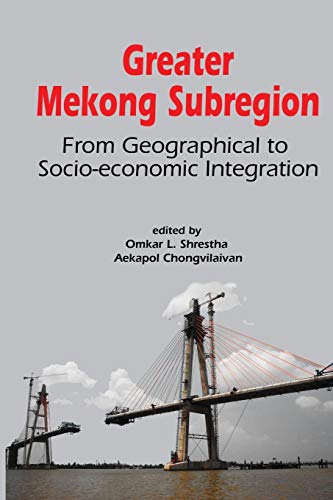
Greater Mekong subregion : from geographical to socio-economic integration/ [electronic resource] / Aekapol Omkar L.;Chongvilaivan Shrestha.
Call number: 338.959 Call Number: Ebook Material type: TextLanguage: English Publication details: Institute of Southeast Asian Studies, 2013.Description: 287 pISBN:
 - 9789814379687
- 9789814379694
- 338.959
- HC441
Chapter, Lesson, Part 1. Greater Mekong Subregion: Freom Geographical Corridors to Socio-economic Corridors.
Chapter, Lesson, Part 2. Cambodia, Its Development, and Integration into the GMS: A Work in Progress.
Chapter, Lesson, Part 3. Subregional Connectivity in the Lao PDR: From Landlocked Disadvantage to Land-linked Advantage.
Chapter, Lesson, Part 4. The Economic Development of Myanmar and the Relevance of the Greater Mekong Subregion.
Chapter, Lesson, Part 5. GMS Challenges for Thailand.
Chapter, Lesson, Part 6. Deepening GMS Cooperation in a More Integrated ASEAN and East Asia.
Chapter, Lesson, Part 7. China (Yunnan)-GMS Economic Cooperation: New Development and New Problems.
Chapter, Lesson, Part 8. Trade and Investment in the Greater Mekong Subregion: Remaining Challenges and the Unfinished Policy Agenda.
Chapter, Lesson, Part 9. Enhancing Financial Cooperation among the GMS Countries by Ulrich Volz.
Chapter, Lesson, Part 10. The Challenges of GMS Regional Integration: Case Study of Governance of the Logistics Industry in Thailand.
Chapter, Lesson, Part 11. Energy Sector Integration for Low-Carbon Developent in GMS: Towards a Model of South-South Cooperation.
Chapter, Lesson, Part 12. Linking the Social to the Economic: Broadened Ambitions and Multiple Mitigations in New Mekong Corridors.
Cover, Title,Greater Mekong subregion : from geographical to socio-economic integration--Preface, Introduction, TOC,Contents--Preface, Introduction, TOC,Preface--Preface, Introduction, TOC,List of Abbreviations--Preface, Introduction, TOC,Contributors--References, Appendix, Index,Index.
The large market size and abundant resources of the Greater Mekong Subregion (GMS), including a large, motivated and cheap workforce, a rich agricultural base, extensive timber and fisheries resources, considerable potential mineral resources, and vast energy resources have seen the subregion increasingly recognized as a new frontier of Southeast Asian economic strength. This book aims to assess the recent economic, social and political developments in the GMS and identify emerging opportunities and challenges facing the successful transition towards a market-driven economy.
There are no comments on this title.


